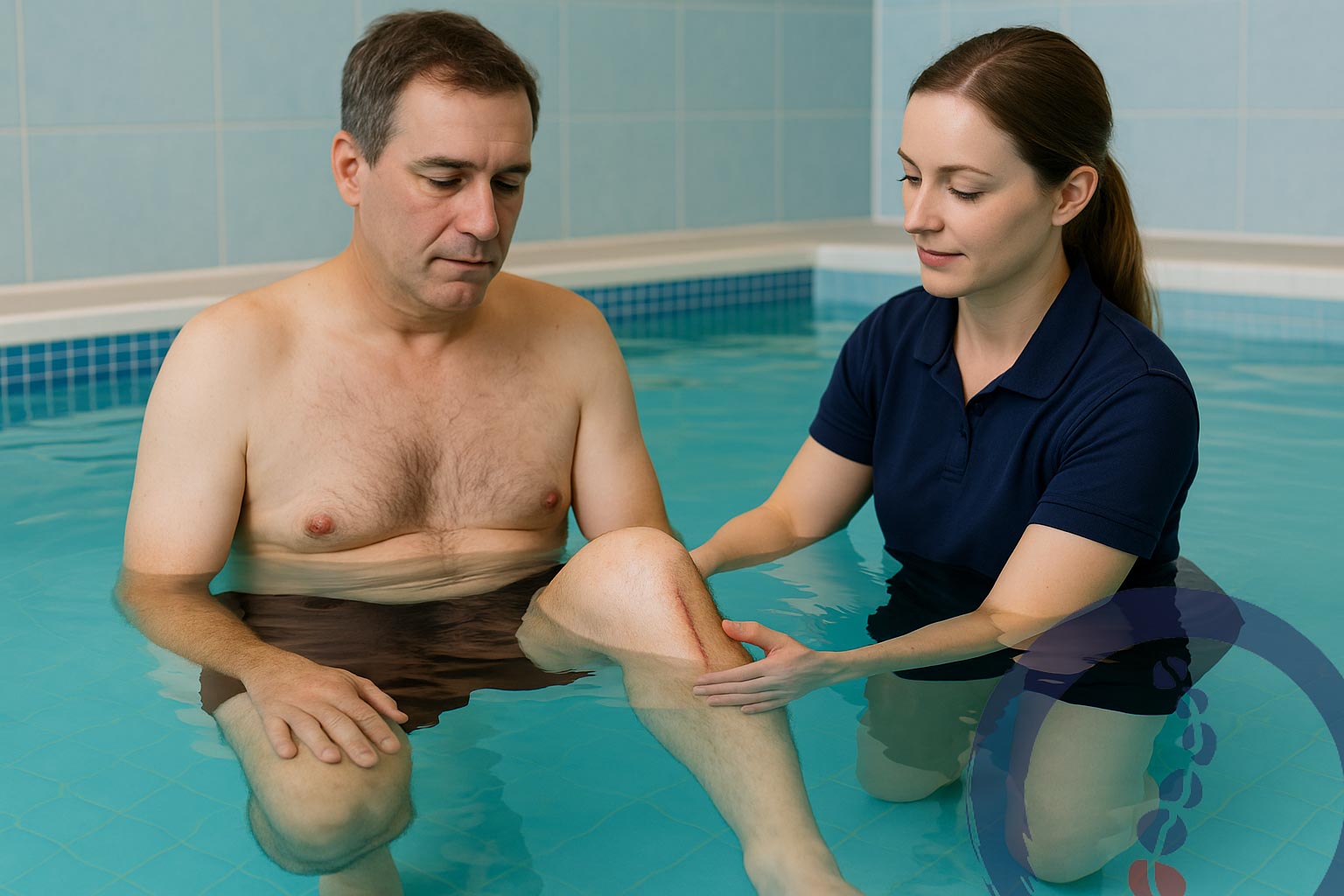
Hydrotherapy uses the physical properties of water to create a different environment for movement, exercise and rehabilitation. Rather than simply exercising in a swimming pool, clinical hydrotherapy involves individually selected activities performed in warm water under appropriate professional supervision.
Understanding how hydrotherapy works starts with three important properties of water: buoyancy, resistance and temperature. Together, these can change how the body is supported and how movement and exercise are performed compared with rehabilitation on land.
This makes hydrotherapy a useful rehabilitation option for some people with neurological, musculoskeletal, post-surgical or mobility-related needs.
How does hydrotherapy work?
When the body enters water, the forces acting on it change. Water can support part of the body’s weight while simultaneously providing resistance to movement.
A physiotherapist can use these properties to modify exercises according to the person’s physical abilities and rehabilitation goals.
Hydrotherapy is therefore not defined by one particular set of exercises. The programme should be adapted according to the individual, their condition and what they are working towards.
Buoyancy: reducing the effects of body weight
One of the most important properties used in hydrotherapy is buoyancy.
When part of the body is immersed, water provides an upward force that supports some of its weight. This changes the amount of load experienced during certain movements compared with exercising on land.
For some people, this can create an environment in which movements can be practised differently, particularly when weight-bearing, weakness, pain or reduced mobility makes land-based exercise more challenging.
The amount of support provided by the water also changes according to immersion depth, giving the physiotherapist another way of adapting an exercise.
Water resistance: using the pool for strengthening
Water does more than support the body. It also provides resistance when we move through it.
This resistance can be used during rehabilitation to progressively challenge muscles and movement control without necessarily requiring conventional gym equipment.
The difficulty of an exercise can be modified by changing factors such as movement speed, direction, surface area or the equipment being used.
This allows strengthening activities to be adapted according to the person’s abilities and stage of rehabilitation.
Why is hydrotherapy performed in warm water?
Clinical hydrotherapy is generally performed in water maintained at a temperature appropriate for therapeutic exercise rather than in a conventional swimming environment.
Warm water can make the aquatic environment more comfortable for movement and may help some people feel less stiff or tense while exercising.
Temperature is only one part of hydrotherapy, however. The clinical value of a session comes from combining the aquatic environment with an exercise programme designed around the individual’s rehabilitation needs.
Hydrotherapy and movement
Movement on land is strongly influenced by gravity and body weight. In water, buoyancy changes these forces.
For some patients, this can provide different opportunities to practise movements such as:
- Walking and stepping
- Joint movement
- Balance activities
- Strengthening exercises
- Functional movement
- Coordination exercises
The objective depends on the individual. Hydrotherapy for someone recovering from orthopaedic surgery, for example, may look very different from aquatic rehabilitation for someone with a neurological condition.
How hydrotherapy can support rehabilitation
Hydrotherapy can be incorporated into rehabilitation when the properties of water provide a useful environment for working towards specific goals.
Depending on the individual, these goals may include improving movement, building strength, working on balance, practising walking or increasing confidence with physical activity.
Hydrotherapy does not necessarily replace physiotherapy on land. The two environments can complement each other as part of an individual rehabilitation programme.
For information about treatment rather than how hydrotherapy works, visit Bluebell’s specialist Hydrotherapy service.
Hydrotherapy for neurological rehabilitation
Neurological conditions can affect movement through changes in strength, balance, coordination, mobility or muscle tone.
For some neurological patients, the support provided by water creates another environment in which movement and functional activities can be practised under supervision.
The programme needs to reflect the person’s neurological presentation and individual goals rather than using a standard series of pool exercises.
Find out more about Bluebell’s neurological rehabilitation.
Hydrotherapy after surgery
The aquatic environment can also form part of rehabilitation following certain surgical procedures when the patient has reached an appropriate stage of recovery.
Buoyancy can alter weight-bearing while water resistance can be used progressively for movement and strengthening exercises.
However, factors such as wound healing, infection risk, surgical precautions and medical guidance need to be considered before entering a hydrotherapy pool after surgery.
We explain this in more detail in our guide to post-surgical hydrotherapy and recovery after surgery.
How does hydrotherapy work for children?
The same physical properties of water can also be used in paediatric rehabilitation, but the therapeutic approach needs to reflect the child’s age, abilities, condition and developmental goals.
Activities can be adapted to work on movement, strength, balance, coordination and confidence in an aquatic environment.
Parents and carers looking specifically for children’s treatment can learn more about Bluebell’s Paediatric Hydrotherapy service.
We also explain the therapeutic approach in more detail in our guide to hydrotherapy in paediatric care.
Is hydrotherapy suitable for everyone?
No. Hydrotherapy is not automatically appropriate for every patient or every condition.
Medical history, cardiovascular and respiratory considerations, skin conditions, wounds, infection risk, continence, mobility and other individual factors may need to be considered before treatment.
Assessment helps determine whether hydrotherapy is appropriate and how the aquatic programme should be adapted.
Hydrotherapy or land-based physiotherapy?
Hydrotherapy and land-based physiotherapy provide different rehabilitation environments.
Water provides buoyancy and resistance, while land-based rehabilitation allows movement and exercise to be practised under normal gravitational and weight-bearing conditions.
Depending on the person’s needs, treatment may involve one approach or a combination of both.
If you are unsure about the difference, read our guide to hydrotherapy and physiotherapy.
What happens during a hydrotherapy session?
A hydrotherapy programme should begin with an understanding of the person’s condition, physical abilities and rehabilitation goals.
Exercises in the pool can then be selected and adapted accordingly, with progression based on how the individual responds.
If you are considering hydrotherapy for the first time, our guide explains what to expect during your first hydrotherapy session.
Specialist hydrotherapy at Bluebell
Bluebell Hydro & Physio provides specialist hydrotherapy as part of personalised rehabilitation programmes for people with a range of physical and neurological needs.
The purpose of treatment is not simply to exercise in water, but to use the properties of the aquatic environment in a clinically appropriate way to work towards individual rehabilitation goals.
If you are looking for hydrotherapy treatment in Birmingham rather than general information about how it works, visit our Hydrotherapy service for treatment and booking information.